

walking for weight loss: how many steps you actually need (2026 science-based guide)
Walking for weight loss is the most underrated fat loss tool in fitness — and I say that as someone who programs heavy squats, deadlifts, and bench presses for a living. After coaching 500+ body transformations at Belk Body Lab in Charleston, South Carolina, I can tell you that the clients who hit their step targets consistently lose more fat, retain more muscle, and sustain their results longer than those who rely on aggressive gym cardio alone. The question is not whether walking helps you lose weight — the research is unequivocal that it does. The question is how many steps you actually need, how to structure a walking workout plan that fits your life, and how to avoid the common mistakes that turn walking into wasted time.
Does Walking Help You Lose Weight? What the Science Actually Says
Walking exercise for weight loss works because it increases your total daily energy expenditure (TDEE) without spiking cortisol, crushing your joints, or creating the ravenous hunger that follows high-intensity cardio. In the fat loss equation, walking falls under NEAT — Non-Exercise Activity Thermogenesis — which accounts for 15-30% of your total daily calorie burn.
A 2023 meta-analysis in the British Journal of Sports Medicine confirmed that adults who walked 8,000+ steps per day had significantly lower body fat percentages than sedentary controls, independent of diet changes. A 2024 study in JAMA Internal Medicine found that each additional 2,000 daily steps reduced all-cause mortality risk by 8-11% and was associated with measurable reductions in visceral fat.
Here is what I tell every new client: if you are currently averaging 3,000-4,000 steps per day, simply increasing to 8,000-10,000 steps creates an additional daily caloric expenditure of 200-400 calories. Over a month, that is 6,000-12,000 extra calories burned — the equivalent of 1.7-3.4 pounds of body fat — without changing a single thing about your diet. When you combine this with the moderate caloric deficit I outline in my fat loss guide, the results compound dramatically.
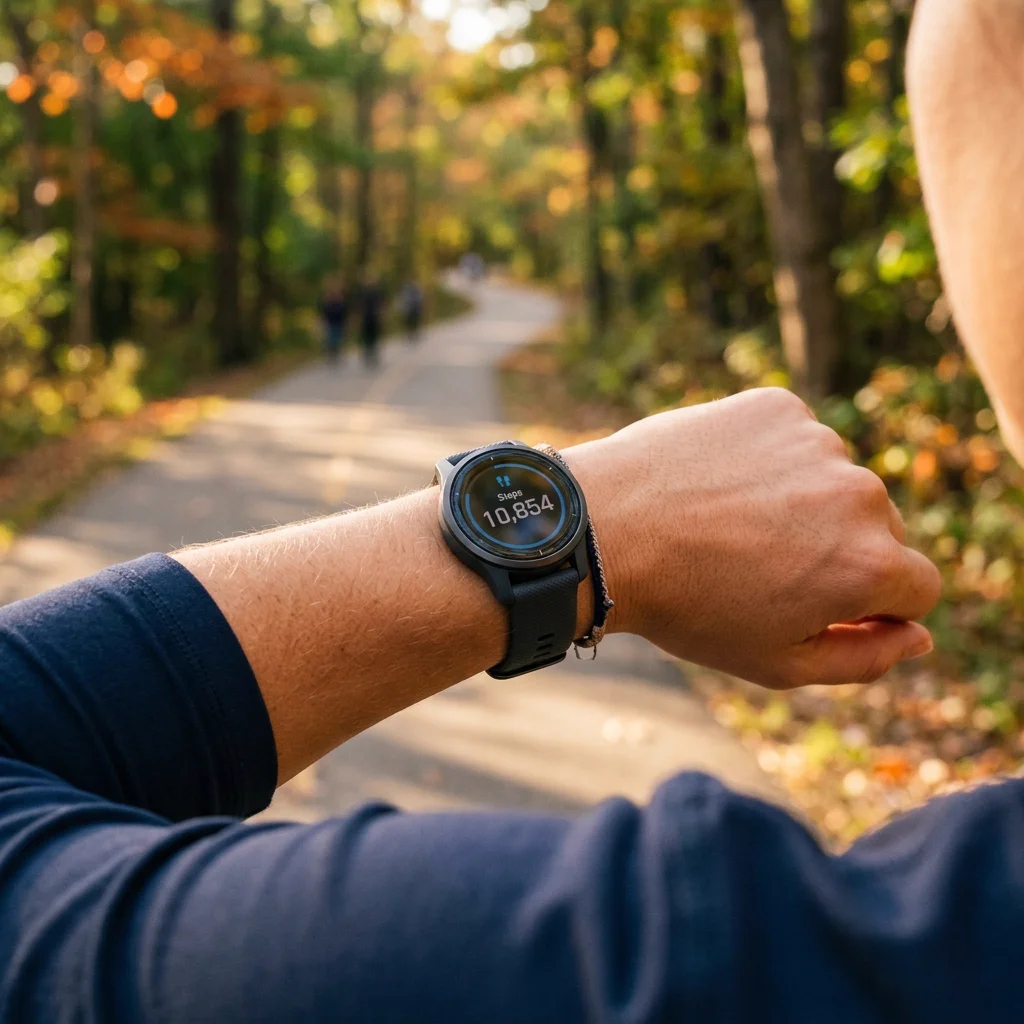
How Many Steps a Day to Lose Weight?
The honest answer is there is no single magic number — but the research points to a clear range:
- Sedentary baseline (under 4,000 steps): Start by adding 2,000 steps per day. This alone creates measurable change.
- Moderate activity (4,000-6,000 steps): Build toward 7,500-8,000 steps daily. This is where the fat loss curve steepens significantly.
- Active fat loss phase (8,000-10,000 steps): This is the sweet spot for most people. 10,000 steps weight loss is well-supported by research.
- Aggressive fat loss (10,000-15,000 steps): I program this range for clients in the final 4-6 weeks of a cut. Beyond 15,000, the returns diminish.
Calorie Burn by Body Weight and Step Count
How much walking to lose weight depends heavily on your body weight. Here are evidence-based estimates for moderate-pace walking (3.0-3.5 mph) on flat terrain:
| Body Weight | 5,000 Steps | 7,500 Steps | 10,000 Steps | 12,500 Steps |
|---|---|---|---|---|
| 140 lbs | ~175 cal | ~260 cal | ~350 cal | ~435 cal |
| 170 lbs | ~210 cal | ~315 cal | ~420 cal | ~525 cal |
| 200 lbs | ~250 cal | ~375 cal | ~500 cal | ~625 cal |
| 230 lbs | ~290 cal | ~430 cal | ~575 cal | ~720 cal |
| 260 lbs | ~325 cal | ~490 cal | ~650 cal | ~815 cal |
Note: Incline walking, brisk pace, or carrying a weighted vest can increase these numbers by 30-60%.
Walking vs Running for Weight Loss: Why Walking Often Wins
Running burns more calories per minute than walking — that is a fact. But here is the coaching reality I see with hundreds of clients:
- Recovery cost: Running requires 24-48 hours of recovery that competes with your strength training. Walking requires essentially zero recovery.
- Muscle preservation: Walking does not create the catabolic environment that chronic running does. When you are in a caloric deficit, preserving lean mass is everything. Read our body recomposition guide for the full science.
- Sustainability: My clients who run for fat loss burn out within 4-6 weeks. My clients who walk sustain the habit for months and years.
- Appetite regulation: Running increases ghrelin (hunger hormone) substantially. Walking has a neutral or mildly appetite-suppressing effect, making it far easier to maintain your caloric deficit and macro targets.
"I program running for exactly one type of client: the one training for a race. For everyone else pursuing fat loss, walking is the superior tool." — Kyle Belk, NASM-CPT
Japanese Walking for Weight Loss: The 2026 Trending Method
Japanese walking — also called interval walking or the Shinshu University method — has surged in popularity in 2026, and for good reason. The protocol alternates between 3 minutes of brisk, fast-paced walking (around 70% of your max effort) and 3 minutes of moderate, comfortable walking. This cycle repeats for 20-40 minutes.
Research from the Shinshu University study found that interval walkers lost significantly more body fat, improved their VO2 max by 14%, and reduced blood pressure more effectively than those who walked at a constant moderate pace. The mechanism is similar to high-intensity interval training (HIIT) but without the joint impact and recovery cost.

How to Do Japanese Interval Walking:
- Warm up: 3-5 minutes of easy walking
- Brisk interval: Walk as fast as you can without running for 3 minutes
- Recovery interval: Return to a comfortable pace for 3 minutes
- Repeat: Complete 5-7 cycles (30-42 minutes total)
- Cool down: 3-5 minutes of easy walking
Walking to Lose Belly Fat: What the Research Shows
Belly fat — specifically visceral adipose tissue — is the most metabolically dangerous fat in your body and the most responsive to consistent walking. A 2024 study published in Obesity found that participants who walked 10,000+ steps daily for 12 weeks reduced visceral fat by 7.4%, even without dietary changes. When combined with a moderate caloric deficit, visceral fat reductions reached 12-18%.
For a comprehensive approach to losing stubborn abdominal fat, see our complete belly fat loss guide or our guide specifically for adults over 40.
The 4-Week Progressive Walking Plan for Beginners
This walking plan for beginners is exactly what I use with new Belk Body Lab clients starting from a sedentary baseline. The key is progressive overload — the same principle we apply to strength training.
| Week | Daily Step Target | Walks/Week | Walk Duration | Style |
|---|---|---|---|---|
| Week 1 | 5,000-6,000 | 5 | 20-25 min | Steady moderate pace |
| Week 2 | 6,500-7,500 | 6 | 25-30 min | Moderate + 1 Japanese interval session |
| Week 3 | 8,000-9,000 | 6-7 | 30-40 min | Moderate + 2 Japanese interval sessions |
| Week 4 | 9,000-10,000 | 7 | 35-45 min | Moderate + 2-3 Japanese interval sessions |
Pro tips: Split your walks if needed — two 15-minute walks burn the same calories as one 30-minute walk. Morning walks before breakfast can increase fat oxidation by 10-20%. Evening walks after dinner improve insulin sensitivity and sleep quality. Treat your steps like a prescription: non-negotiable.
Walking + Strength Training: The Fat Loss Multiplier

Walking alone will help you lose weight. Walking combined with strength training will transform your body:
- Strength training builds metabolically active tissue. Each pound of muscle burns approximately 6-7 calories per day at rest.
- Walking creates the caloric deficit without the cortisol. Aggressive cardio raises cortisol, which promotes muscle breakdown. Walking keeps cortisol low.
- The combination preserves your physique. Clients who only walk lose weight but often end up "skinny fat." Clients who walk and lift lose fat specifically while muscles become more defined.
My standard fat loss protocol: 3-4 days of strength training focused on the best compound exercises for fat loss, plus daily walking targets of 8,000-10,000 steps.
Common Walking Mistakes That Stall Fat Loss
- Eating back your walking calories: Fitness trackers overestimate calorie burn by 30-50%. Do not eat those calories back.
- Walking without a nutrition plan: Walking alone, without managing caloric intake, will produce slow results. Our sustainable shred guide covers how to structure your nutrition.
- Same route, same pace, every day: Your body adapts after 3-4 weeks. Vary terrain, pace, and duration.
- Skipping strength training: Walking without resistance training leads to muscle loss during a deficit.
GET YOUR CUSTOM WALKING + FAT LOSS PROTOCOL
Stop guessing how many steps you need. Get a complete fat loss protocol — walking targets, strength training, and nutrition — built for your body and goals by a NASM-certified coach with 500+ transformations.
Apply for Coaching →Questions &
Answers
If your question isn't answered here, reach out directly — Kyle responds personally.
Research supports 7,500 to 10,000 daily steps for meaningful fat loss. Increasing from 3,000-4,000 to 8,000-10,000 steps can burn an additional 200-400 calories per day — enough to lose 1.5-3 pounds of fat per month even without dietary changes.
Yes. Walking at a moderate pace preferentially burns fat as fuel, and studies show that 10,000+ daily steps for 12 weeks can reduce visceral belly fat by 7-18% depending on whether you also maintain a caloric deficit.
For most people pursuing fat loss, yes. Walking creates zero recovery cost, preserves muscle mass, does not spike hunger hormones, and is sustainable for months. Running causes more joint stress, muscle loss, and hunger — leading to higher dropout rates.
Japanese walking alternates 3 minutes of brisk fast-paced walking with 3 minutes of moderate walking for 20-40 minutes. Research shows it burns 20-30% more calories than steady-pace walking and produces greater reductions in body fat.
Approximately 350 calories for a 140 lb person, 420 for 170 lbs, 500 for 200 lbs, and 575 for 230 lbs. Brisk pace and incline can increase these by 30-60%.
A 30-minute walk covers approximately 3,000-4,000 steps and burns 100-200 calories depending on your weight. Combined with a moderate caloric deficit, this can contribute to meaningful fat loss — especially for beginners.
Both have benefits. Fasted morning walking can increase fat oxidation by 10-20%. Walking after dinner improves insulin sensitivity and sleep quality. The best time is whichever you will do consistently.
No. Fat loss benefits increase significantly around 7,500 steps per day. Hitting 7,500-8,000 steps seven days a week produces better results than 12,000 steps three days a week. Consistency over intensity.
Walking alone can produce modest fat loss of 0.5-1 pound per month. Combining walking with a 300-500 calorie deficit dramatically accelerates results to 1-2 pounds per week.
Most people notice changes within 3-4 weeks of consistent walking at 8,000-10,000 steps combined with a caloric deficit. Visible body composition changes typically appear by weeks 4-6.

