peptides for fitness & body composition: what charleston trainers are actually being asked
Evidence-based guide — last updated August 2026. All content is provided for educational and fitness-professional purposes. Nothing here constitutes medical or pharmacological advice. Consult a licensed clinician for any health decisions.
Charleston personal trainers are fielding a new kind of question at the squat rack. Between sets, in intake consultations, and in the group chat after a GLP-1 prescription lands, clients want to know whether peptides are the next tool for body composition — and whether they're "basically steroids." The honest answer is more nuanced than either the marketing pages or the message-board panic suggest.
Peptides are a broad, structurally distinct category from anabolic steroids. GLP-1 medications are reshaping how trainers think about muscle preservation during fat loss. And the compounds getting the most gym-floor attention — BPC-157, TB-500, GHK-Cu, and blended formulas like KLOW — are still, for the most part, research-stage tools rather than approved therapeutics.
This guide walks through what the published research actually shows, where it stops, and how the questions a client brings to a trainer differ from the questions a laboratory researcher is trying to answer. It's written for people asking the question — not for people trying to sell them an answer.
Quick Answer
Peptides and anabolic steroids are different compound classes: peptides are short amino-acid chains that signal through cell-surface receptors, while steroids are testosterone-derived molecules that alter gene expression directly through nuclear receptors. Most performance-related peptides — BPC-157, TB-500, GHK-Cu, and blended formulas — remain unapproved for human use and are studied in laboratory research settings rather than prescribed clinically. GLP-1 medications like semaglutide do cause some lean-mass loss during weight loss — published trial data ranges from roughly a fifth to nearly half of total weight lost — but resistance training and adequate protein intake meaningfully reduce that loss.
Key Takeaways
- Peptides and anabolic steroids work through fundamentally different biological mechanisms — comparing them as interchangeable performance tools misses the point.
- Most peptides discussed in gyms and online communities (BPC-157, TB-500, GHK-Cu) are sold and studied as research compounds, not approved drugs for human use.
- GLP-1 receptor agonists can account for a meaningful share of total weight loss coming from lean tissue — published data ranges roughly 20% to over 40% depending on the study and drug.
- Resistance training combined with adequate protein intake is the best-documented strategy for preserving lean mass during any rapid weight-loss protocol, GLP-1-assisted or not.
- "Research use only" labeling reflects a compound's clinical-trial and regulatory status, not a marketing gimmick.
- Purity documentation (a Certificate of Analysis) matters more for peptides than for most supplements, because manufacturing quality varies widely across suppliers.
Why Trainers Are Being Asked About Peptides
Three trends converged to put peptides in front of personal trainers who never signed up to answer pharmacology questions. GLP-1 medications went from an endocrinology niche to a mainstream weight-loss conversation in a few years, and clients on semaglutide or tirzepatide now ask their trainers how to protect the muscle they're working to build while the drug is doing its job. Longevity and biohacking media coverage put recovery peptides like BPC-157 and TB-500 in front of a general fitness audience, often stripped of the caveats that accompany the actual research. And direct-to-consumer peptide brands market blended products — KLOW, GLOW, and similar formulas — with fitness-adjacent branding that lands squarely in a trainer's client base.
Most certification programs don't cover peptide pharmacology, which leaves a real information gap. This guide exists to close part of that gap responsibly: with what the research supports, what it doesn't, and where a trainer's role should end and a licensed clinician's or a researcher's own reading should begin.

What Are Research Peptides?
Definition
A peptide is a short chain of amino acids — the same building blocks that make up proteins, just fewer of them, linked in a specific sequence. That sequence determines what the peptide does: some mimic natural signaling hormones, some bind growth-hormone-related receptors, and others are studied for tissue-repair or inflammatory pathways. There is no single "peptide mechanism" — the category is defined by structure, not by function.
Peptide size varies enormously. GHK-Cu is a tripeptide of three amino acids bound to a copper ion. BPC-157 is 15 amino acids. TB-500 (thymosin beta-4 fragment) is 43. That range matters because a three-amino-acid copper complex and a 43-amino-acid fragment behave very differently in the body, even though both get grouped under "peptides" in casual conversation.
Most of the compounds discussed in this article are sold and studied as research chemicals — labeled "research use only" (RUO) — rather than as approved medications. That label reflects where a compound sits in the regulatory and clinical-trial process, not a judgment on whether it's interesting scientifically. Insulin and GLP-1 receptor agonists are also peptides, and those are FDA-approved prescription medicines; the category spans from approved drugs to unapproved laboratory research compounds.
Peptides vs. Steroids: The Actual Mechanisms
This is the comparison trainers get asked about most, and it's worth answering precisely rather than with a soundbite.
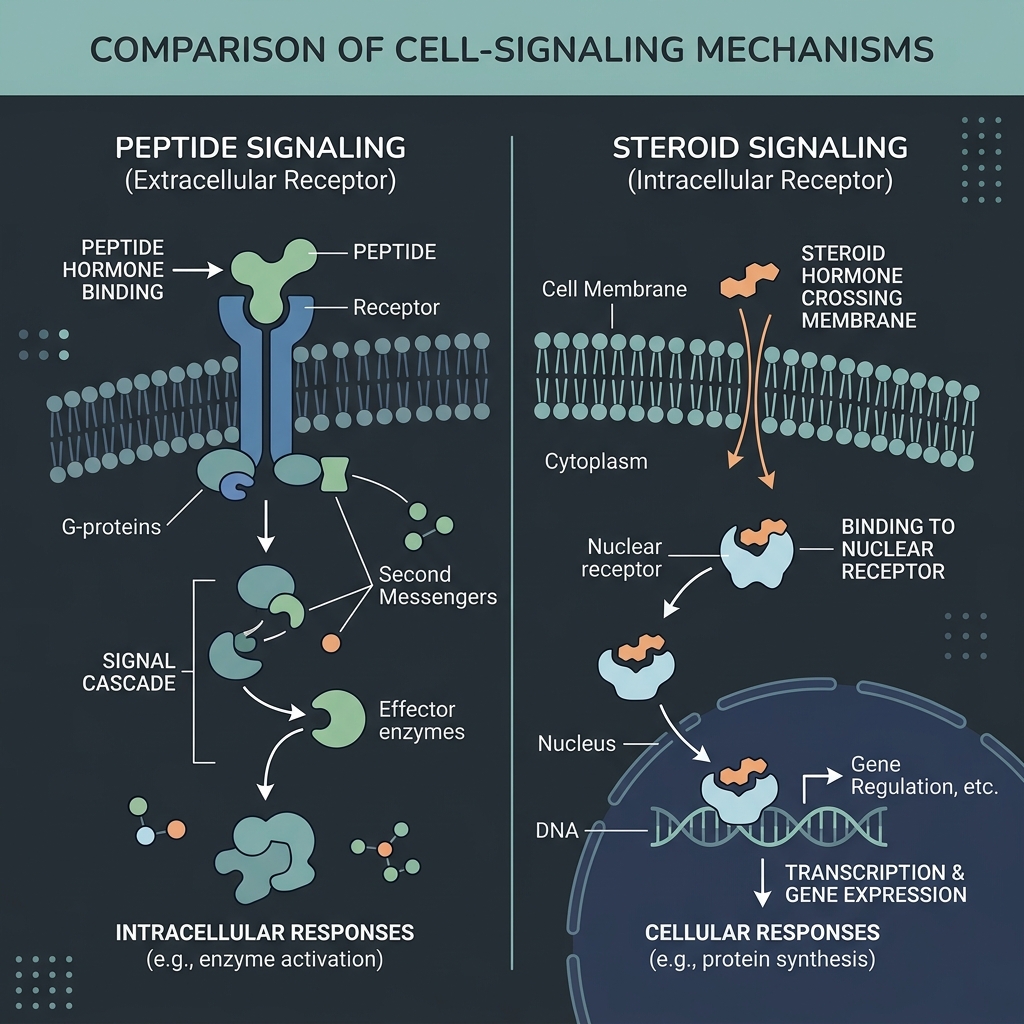
| Dimension | Peptides | Anabolic-Androgenic Steroids |
|---|---|---|
| Structure | Short amino-acid chains | Testosterone-derived, four-ring lipid structure |
| Mechanism | Bind cell-surface receptors, trigger signaling cascades | Cross the cell membrane, bind nuclear androgen receptors, directly alter gene transcription |
| Scope of effect | Often narrower / tissue-specific depending on the peptide | Broad, systemic effects across androgen-sensitive tissue |
| HPG axis / natural testosterone | Most research peptides do not suppress it | AAS commonly suppress natural testosterone production |
| Regulatory status | Wide range — FDA-approved drugs to unapproved RUO compounds | Schedule III controlled substances in the US when used non-medically |
| Documented risk profile | Varies by compound; limited long-term human safety data for most research peptides | Well-documented cardiovascular, hepatic, and endocrine risks in the literature |
The practical takeaway: peptides and anabolic steroids aren't two versions of the same tool. They're different compound classes with different mechanisms, different regulatory histories, and different bodies of safety literature. A client asking "should I do peptides instead of steroids" is often really asking "is there a safer way to get X result," and the honest answer depends entirely on which peptide, which steroid, and which outcome they mean.
The Peptides Clients Ask About Most
BPC-157 and TB-500 (Recovery Research)
BPC-157 and TB-500 come up constantly in conversations about tendon, ligament, and soft-tissue recovery. The research base is almost entirely preclinical — animal models rather than controlled human trials — and centers on mechanisms like upregulated growth-factor receptor activity and angiogenesis (new blood vessel formation) in injured tissue. Some early-phase human research on BPC-157-related compounds for gastrointestinal conditions exists in the literature, but current peptide products sold for research use are not approved for human therapeutic use in the US, and there is no established human dosing standard drawn from controlled clinical trials.
GHK-Cu (Copper Peptide Research)
GHK-Cu has one of the longer, better-documented research histories in this category — it was first isolated from human plasma in 1973 and has been studied since for its role in collagen synthesis, wound healing, and skin remodeling. Laboratory research has linked it to fibroblast activity, extracellular matrix repair, and antioxidant effects. It's one of the more mechanistically well-characterized peptides in this space, though most of that evidence comes from cell-culture and animal studies rather than large human trials.
Blended Formulas (KLOW, GLOW, and Similar Products)
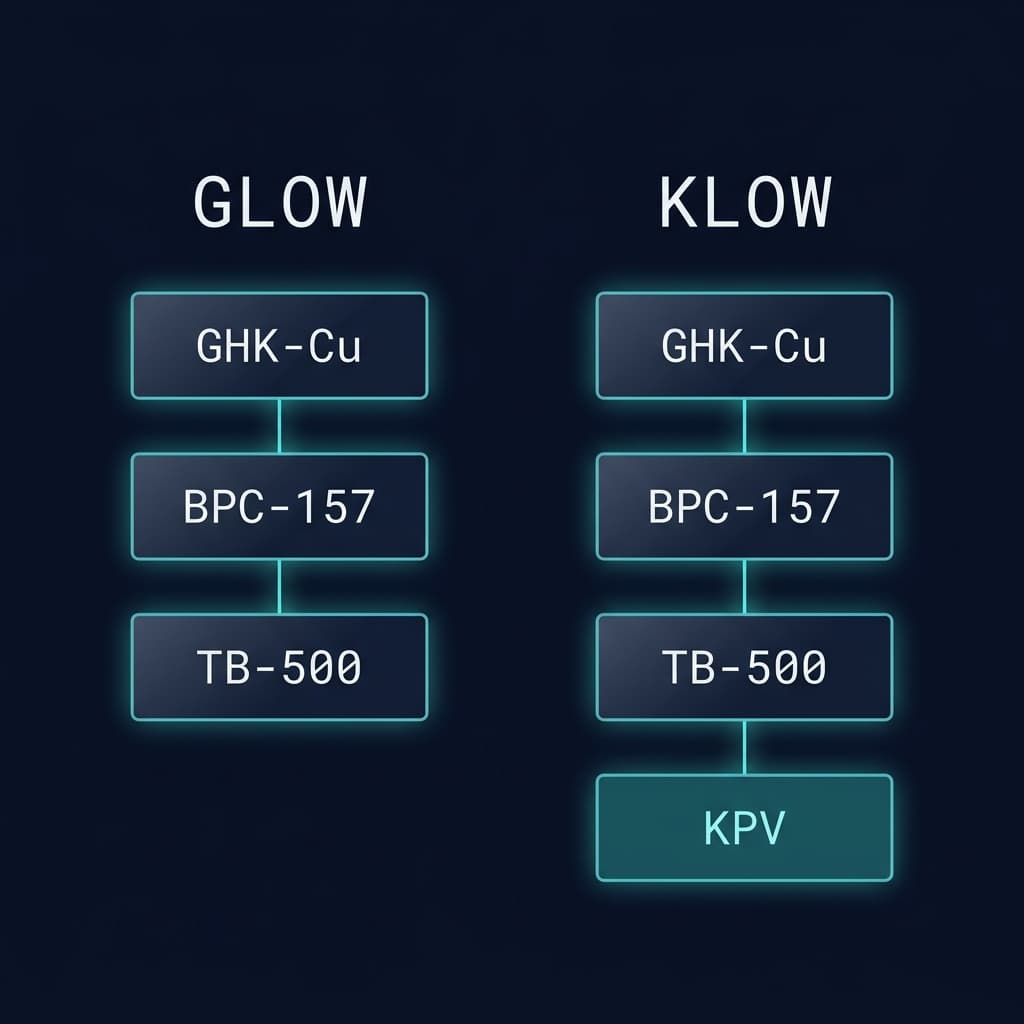
Multi-peptide blends combine several of the compounds above — typically GHK-Cu, BPC-157, TB-500, and sometimes KPV — into a single product marketed around recovery and tissue-repair research. A blend is only as well-understood as its individual components, and the interaction effects of combining several peptides are less studied than any single compound on its own. Anyone evaluating a synergistic peptide blend like KLOW and GLOW should understand what each ingredient does individually before assuming the combination behaves predictably.
GLP-1 Peptides and Muscle Preservation During Fat Loss
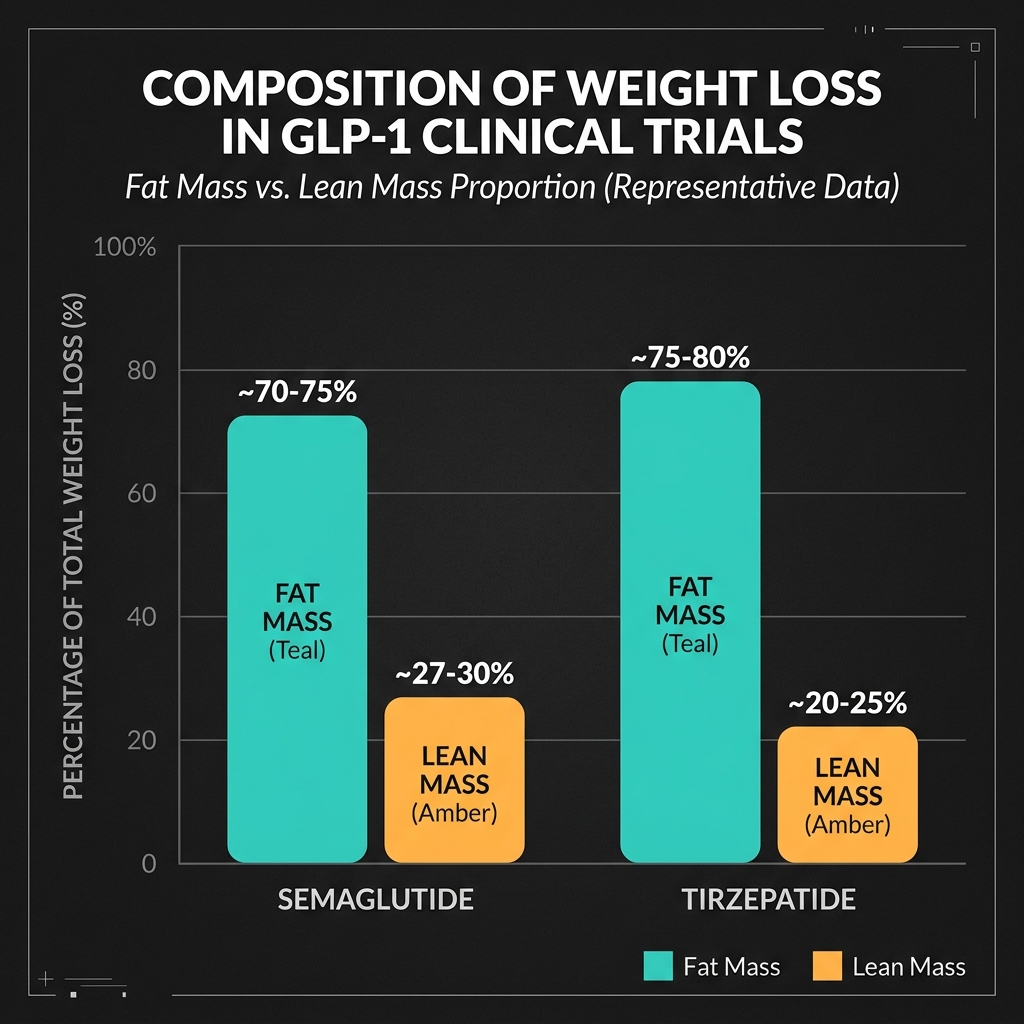
This is where the research is strongest and most directly useful to a trainer. GLP-1 receptor agonists (semaglutide) and dual GLP-1/GIP agonists (tirzepatide) reliably produce large amounts of fat loss — but a meaningful share of total weight lost on these medications comes from lean tissue, not fat.
| Data Point | Finding |
|---|---|
| STEP-1 body-composition substudy (semaglutide) | Lean mass decreased ~9.7% while fat mass fell ~19.3% — fat loss predominates, but lean-mass loss is measurable |
| SURMOUNT-1 substudy (tirzepatide) | Roughly 25% of total weight lost was lean tissue |
| Range across systematic reviews | Estimates place lean mass at roughly 15–40% of total weight lost, varying by drug, dose, and duration |
| Resistance training + protein intervention research | Structured resistance training during caloric restriction has been shown to preserve the large majority of lean mass that would otherwise be lost |
The mechanism question — whether this lean-mass loss is an adaptive, proportional response to rapid weight loss or something to actively fight — is still being studied. What's well-supported across multiple reviews is the intervention: resistance training, prioritized over aerobic-only routines, combined with adequate protein intake (commonly cited research ranges run from about 1.2 to 1.6 grams per kilogram of body weight per day, with some clinical guidance going higher for very active clients) measurably reduces the proportion of weight lost from lean tissue. For a trainer working with a GLP-1 client, that's the actionable finding: programming resistance work isn't optional context, it's the documented lever.
Common Misconceptions
"Peptides are just legal steroids." Not accurate — different structure, different mechanism, different regulatory category entirely.
"If something is labeled research use only, it must be illegal." RUO reflects a compound's clinical-trial and regulatory status, not automatic illegality; the specifics vary by compound and jurisdiction, so this isn't something to guess about.
"GLP-1 drugs only burn fat." Partially false — clinical body-composition data consistently shows some lean-mass loss alongside fat loss.
"Peptide blends are just marketing." Partially true, partially false — the individual ingredients have real, distinct research bases; the marketing around the combination often outruns what's actually been studied about the combination itself.
What the Research Shows vs. What Marketing Claims
| Common Marketing Claim | What the Research Actually Supports |
|---|---|
| "Guaranteed muscle growth" from a recovery peptide | Preclinical, mechanism-level evidence for tissue repair in animal models — not controlled human muscle-growth trials |
| "Safer than steroids, so it's safe" | A different risk profile isn't the same as a well-established one; long-term human safety data is limited for most research peptides |
| "GLP-1 drugs won't touch your muscle if you eat enough protein" | Protein and resistance training substantially reduce, but don't fully eliminate, lean-mass loss in the published data |
| "All peptides work the same way" | Mechanisms vary widely by compound — a copper-binding tripeptide and a 43-amino-acid fragment aren't interchangeable |
Purity, Sourcing, and Why Documentation Matters
Because most peptides in this category are unregulated as consumer products, manufacturing quality varies far more than it does for something like a standardized medication. A Certificate of Analysis (COA) — lab documentation showing a product's verified purity and composition, typically via HPLC or mass spectrometry — is the closest thing to a quality standard in this space. Anyone reading peptide research, or sourcing compounds to study, should treat COA availability and third-party testing as a baseline expectation, not an extra. You can view certificates and lab-tested COA reports at 99 Purity Peptides as an example of what thorough documentation looks like.
Research note: When evaluating a peptide supplier, ask for the actual chromatogram, not just a summary figure. Batch-level per-compound quantitation (for blends) and confirmation via both HPLC and mass spectrometry are the meaningful signals of quality in this space.
Where to Keep Learning
This article stays in fitness-audience territory on purpose — the mechanism-level science, purity standards, and reconstitution math live on 99 Purity Peptides' research guides, written for people who want to go deeper. If you're evaluating a specific compound, their Multi-Peptide Basics & Composition pillar and Understanding Peptide Purity guide are good next stops, and their peptide reconstitution calculator is useful if you're already working with research materials and want to double-check your math.
For the specific compounds referenced in this article, the KLOW peptide blend research guide covers that formulation in depth.
Summary
Peptides and anabolic steroids are different compound classes with different mechanisms and different risk profiles — they shouldn't be compared as interchangeable shortcuts to the same result. GLP-1 medications produce real fat loss but also measurable lean-mass loss, and resistance training plus adequate protein is the best-documented way to protect muscle during that process. Most fitness-adjacent peptides (BPC-157, TB-500, GHK-Cu, blended formulas) remain research-stage compounds without established human dosing standards, and purity documentation matters more here than it does for most other products in the fitness space.
Conclusion
The questions clients bring to a Charleston gym floor about peptides deserve a straight answer, not a sales pitch and not a scare headline. Peptides are not steroids. GLP-1 medications are not muscle-safe by default, but resistance training and protein intake meaningfully change the outcome. And most of the compounds generating buzz right now are still research tools, not finished products with a settled human evidence base. Trainers who understand that distinction are better equipped to answer honestly — and to know when a question belongs with a physician, a researcher's own reading of the primary literature, or simply "we don't know yet."
External References
- → Pickart et al., "GHK Peptide as a Natural Modulator of Multiple Cellular Pathways in Skin Regeneration," NIH/PMC
- → SEMALEAN Study: Impact of Semaglutide on Fat Mass, Lean Mass and Muscle Function, NIH/PMC
- → Optimizing GLP-1 Therapies for Obesity and Diabetes Management, NIH/PMC
- → Preserving Musculoskeletal Health Through Resistance Training in GLP-1 Therapy, medRxiv
- → PubMed / NCBI — primary reference for peptide research citations
WORK WITH A CHARLESTON TRAINER WHO UNDERSTANDS THE SCIENCE
Get a strength and body composition program built around your actual goals — whether you're on a GLP-1 medication, asking about peptide research, or just trying to get results without the hype.
Apply for Coaching →Questions &
Answers
If your question isn't answered here, reach out directly — Kyle responds personally.
No. Peptides are short amino-acid chains that bind cell-surface receptors and trigger signaling cascades. Anabolic steroids are testosterone-derived molecules that enter cells and directly alter gene expression through nuclear receptors. They're structurally and mechanistically distinct compound classes, not different versions of the same tool.
BPC-157 is sold in the US as a research-use-only compound, not an approved human medication. Its legal status for research purchase varies by context and has been shifting at the regulatory level, so anyone with specific legal questions should check current guidance rather than assume.
Some peptides, particularly BPC-157 and TB-500, have preclinical research suggesting roles in tissue-repair processes like angiogenesis and growth-factor signaling. That evidence is largely from animal models, not controlled human recovery trials, so it should be read as promising mechanism-level research rather than a proven human outcome.
GLP-1 medications like semaglutide and tirzepatide cause overall weight loss that includes some lean-tissue loss alongside fat loss. Clinical trial data varies by study, but lean mass commonly accounts for a meaningful share — sometimes 20–40% — of total weight lost, though most weight lost is still fat.
In the STEP-1 body-composition substudy, lean mass decreased by roughly 9.7% while fat mass decreased by about 19.3% — meaning fat loss predominated, but lean-mass loss was still measurable. Other reviews report a broader range depending on dose, duration, and starting body composition.
TB-500, a synthetic fragment of thymosin beta-4, is studied in preclinical models for its potential role in tissue repair, including tendon, ligament, and wound-healing research. It remains an unapproved research compound without an established human clinical dosing standard.
GHK-Cu is a copper-binding tripeptide studied since the 1970s for its role in collagen synthesis, wound healing, and skin remodeling. Research links it to fibroblast activity and extracellular matrix repair, primarily in cell-culture and animal studies, with growing interest in cosmetic and dermatological applications.
'Research use only' (RUO) describes a compound that hasn't completed the clinical trials and regulatory approval process required for human medical use. It's sold for laboratory research rather than as a therapeutic product, which is a scientific and regulatory distinction rather than a marketing label.
No. KLOW and GLOW are both multi-peptide blends built around GHK-Cu, BPC-157, and TB-500, but they differ in composition — KLOW typically adds KPV to the formula. The specific ratios and included compounds vary by manufacturer, so checking the exact composition matters.
Resistance training doesn't fully eliminate lean-mass loss during GLP-1-assisted weight loss, but published research shows it substantially reduces the proportion of weight lost from lean tissue compared to caloric restriction alone. It's currently the most consistently supported intervention for this specific concern.
Research on preserving lean mass during GLP-1 therapy commonly cites protein targets in the range of about 1.2 to 1.6 grams per kilogram of body weight per day, spread across meals. Appetite suppression from these medications can make hitting that target harder, which is why meal planning becomes more important.
Safety depends on the individual compounds, the manufacturing quality, and the lack of long-term human trial data for most research peptides. Blends combine multiple unapproved compounds, and the interaction effects of combining them are even less studied than any single ingredient on its own.
Both are chains of amino acids, but peptides are shorter — typically under 50 amino acids — while proteins are longer, more complex chains that often fold into specific 3D structures. The distinction is somewhat arbitrary at the boundary, but it affects how each is absorbed, studied, and used.
Delivery format affects bioavailability differently depending on the peptide's molecular size and stability. Manufacturers offer different formats for research convenience, but format alone doesn't indicate efficacy or research validity — that depends on the compound and the specific research question.
A COA is lab documentation — typically via HPLC or mass spectrometry — verifying a peptide product's actual purity and composition. Because this category isn't regulated like pharmaceuticals, a COA is one of the only ways to confirm what's actually in a vial before using it in research.
Peptides and anabolic steroids work through different mechanisms and aren't direct substitutes for the same effect. Steroids produce faster, more pronounced increases in muscle size through direct androgen-receptor activation; most research peptides don't replicate that mechanism, even where they show other research applications.
Most research peptides don't act on the hypothalamic-pituitary-gonadal (HPG) axis the way anabolic steroids do, so they generally aren't associated with the same testosterone-suppression pattern. This varies by specific peptide, and it's an area where compound-specific research matters more than category-wide generalizations.
No. Both are GLP-1-class medications used for weight management, but tirzepatide is a dual GLP-1/GIP receptor agonist while semaglutide targets the GLP-1 receptor alone. Body-composition research shows broadly similar patterns of fat loss with some lean-mass loss for both, with some differences in magnitude between studies.
Ask whether the supplier provides a current Certificate of Analysis for the specific batch, whether it's tested by an independent third-party lab, how the product is stored and shipped, and whether the listed compound and concentration match what's actually being sold. Vague or missing documentation is a reliable red flag.
Some are — insulin and GLP-1 receptor agonists like semaglutide are FDA-approved prescription medications. Most of the compounds discussed in fitness and recovery contexts, including BPC-157, TB-500, and GHK-Cu, are not approved for human therapeutic use and are sold as research-use-only materials.
Both are studied for tissue-repair research, but they differ in size and origin — BPC-157 is a 15-amino-acid synthetic peptide derived from a protective gastric protein, while TB-500 is a 43-amino-acid fragment of thymosin beta-4. Their proposed mechanisms overlap in some areas (like angiogenesis) but aren't identical.
Treat trainer conversations about peptides as a starting point for your own reading, not a final answer — trainers generally aren't licensed to give medical or pharmacological advice. For anything involving actual use, sourcing, or health decisions, that's a conversation for a licensed clinician or your own review of the primary research.