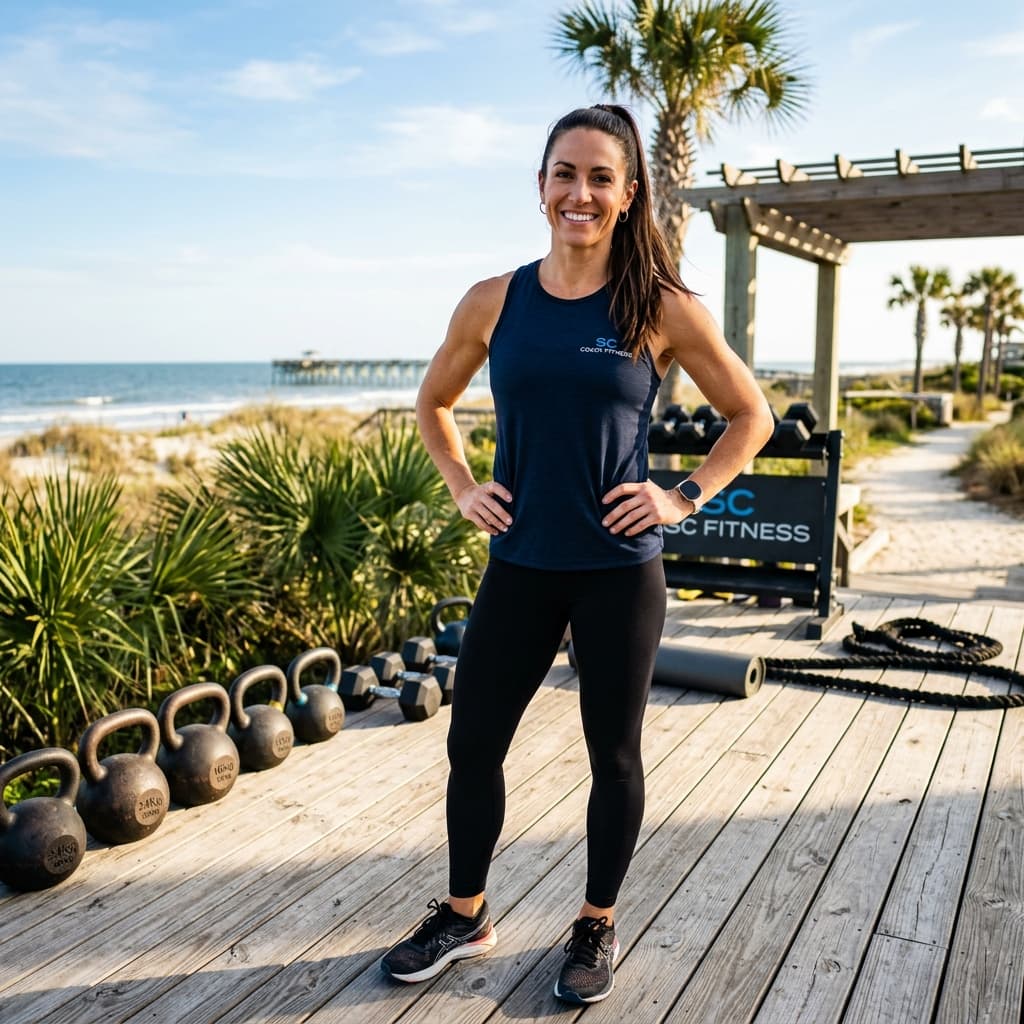
small-group personal training vs. one-on-one personal training in charleston: cost, results, and the right fit
"Should I just join a small group class, or is it worth paying more for one-on-one?" I get some version of this question in almost every consultation I run in Charleston, Mount Pleasant, and Summerville, and the honest answer is: it depends on specifics most people never think to ask about themselves — beginner comfort level, specific injury history, budget, and how much external accountability you actually need to stay consistent. This guide breaks down the real cost differences, who tends to get better results from each format, and how to decide which one actually fits your situation rather than just picking whichever is cheaper or more popular.

Why This Decision Has Gotten More Common in 2026
Community-driven fitness — small-group training, run clubs, creator-led programs — has become one of the defining trends in the fitness industry this year, growing specifically because it feels more social and accessible than traditional solo 1-on-1 sessions for a lot of people, while still offering more structure and coaching than a completely unsupervised gym membership. That's created a genuine, and previously less common, three-way decision for people in Charleston: full one-on-one coaching, small-group semi-private training, or a standard gym membership. This guide focuses on the first two, since that's where the real coaching-quality comparison actually matters.
What's Actually Different Between the Two Formats
Before getting into the comparison table, it's worth naming the misconception that trips up the most people: assuming small-group training is just "a cheaper, watered-down version" of one-on-one. That's not an accurate way to think about it. Both formats can deliver excellent results — they're built around different tradeoffs, not a strict quality hierarchy. The right question isn't "which one is better," it's "which set of tradeoffs actually fits how I learn, what I can afford long-term, and what my body currently needs."
| Factor | One-on-One Training | Small-Group Training |
|---|---|---|
| Typical group size | Just you and the coach | 3-6 clients per session, same coach |
| Programming | Fully individualized every session | Individualized within a shared session structure — same broad workout, personalized loading/modifications |
| Cost per session (Charleston market) | Roughly $75-150+/session for in-person 1-on-1 | Roughly $30-60/session, since the coach's time is split across the group |
| Coaching attention per rep | Continuous — every set is watched and corrected in real time | Rotating — the coach cycles through the group, catching major form issues but not every single rep |
| Schedule flexibility | Fully flexible — booked around your calendar | Fixed class times, less flexible |
| Social/motivational element | Minimal — accountability comes from the coach relationship alone | Built in — group energy and peer accountability are part of the format |
| Best suited for | Complex injury histories, very specific goals, complete beginners who need full attention, executives needing scheduling flexibility | Motivated beginners to intermediates who thrive on group energy, budget-conscious clients, people who want structure without full 1-on-1 cost |
Cost: What You're Actually Paying For
The price gap between these two formats isn't arbitrary — it reflects a straightforward math problem. A coach running a one-on-one session is selling 100% of their attention and expertise to one person for that hour. In a small-group format with four or five clients, that same expertise gets divided, which is exactly why the per-session price comes down proportionally, even though the coach's actual skill and programming knowledge hasn't changed at all. You're not getting "worse" coaching in a small-group format — you're getting the same coach's expertise, applied across a shared session structure instead of a fully custom one.
For context on the broader personal training cost landscape in this market, our personal trainer cost guide breaks down the full range of pricing models, including online coaching, which tends to be the most budget-friendly option of all three.
Who Actually Gets Better Results From One-on-One
- Complete beginners who are intimidated by group settings. If the idea of learning a squat pattern in front of four strangers is enough to keep someone from showing up consistently, that alone makes one-on-one the better choice — the best program in the world doesn't work if you avoid it.
- Anyone with a complex injury history or a current limitation. A client rehabbing a shoulder or working around a chronic back issue needs every rep watched, not just the ones the coach happens to catch while cycling through a group.
- People with very specific, non-standard goals. Marathon-specific periodization, a return-to-sport protocol, or a highly technical strength goal (competitive powerlifting, for example) usually needs a fully custom program that a shared group session structure can't accommodate.
- Executives and professionals needing real scheduling flexibility. If your calendar changes week to week, fixed class times are a genuine barrier to consistency, and consistency is what actually drives results.
Who Actually Gets Better Results From Small-Group Training

- Motivated beginners and intermediates without complex limitations. If you're generally healthy and just need solid coaching plus consistent structure, a small-group format delivers real expertise at meaningfully lower cost.
- People who train harder with others around. Group energy is a legitimate performance and adherence tool for a lot of people — showing up because three other people are expecting you there is a real accountability mechanism, not a lesser one.
- Budget-conscious clients who still want more than an unsupervised gym membership. Small-group training sits in a genuinely useful middle ground between "no coaching at all" and full 1-on-1 pricing.
- Anyone who's found solo training isolating or hard to stick with long-term. If you've started and stopped a gym membership multiple times specifically because training alone gets boring, the social structure of group training directly addresses that failure point.
The Beginner Confidence Question
This deserves its own section because it's the factor I see people get wrong most often in both directions. Some beginners assume group training will be too intimidating and default to one-on-one when they'd actually thrive with peer support once they got past the first session or two. Others assume group training is the "easier" on-ramp and end up frustrated when they need more individualized attention on technique than a group setting can consistently provide. The honest self-assessment question is: do you need someone watching your exact form on every single rep to feel safe and confident, or do you need someone keeping you accountable and correcting major issues while you find your footing? Those are different needs, and neither answer is wrong.
"I've had clients start in one-on-one purely out of nervousness and graduate into small-group training once they had the technical foundation down — and I've had clients do the exact opposite, starting in a group and moving to one-on-one once they hit a more technical goal. Neither path is more legitimate than the other. The format should follow the person's actual needs, not the other way around." — Kyle Belk, NASM-CPT
The Motivation Factor: What the Research Says About Group Training
The social-accountability effect of group training isn't just anecdotal — it's a well-documented phenomenon in exercise psychology research, often referred to as the "Köhler effect," where individuals in a group setting sustain higher effort levels than they would training alone, particularly when they perceive themselves as the weaker link and don't want to be the reason the group underperforms. This is exactly why some people who insist "I'll just push myself harder training alone" consistently end up training harder in a group setting despite their own prediction — the social dynamic changes behavior in ways willpower alone often doesn't. That said, this effect cuts both ways: for someone who finds group settings stressful or self-conscious rather than motivating, the same dynamic can suppress effort and enjoyment instead of boosting it, which is exactly why the beginner-confidence self-assessment above matters so much.
Local Considerations for the Charleston Market Specifically
A few things are worth knowing if you're evaluating this decision specifically in the Charleston, Mount Pleasant, or Summerville area: the personal training market here has grown substantially alongside the area's population growth, meaning there are now considerably more small-group options than there were even five years ago — which is good for choice, but makes vetting coaching quality more important than ever, since group format alone doesn't guarantee good programming. Traffic and commute patterns across the Charleston metro also make schedule flexibility a genuinely practical factor, not just a preference — if a fixed class time consistently conflicts with a commute across the Ravenel Bridge or through peak Mount Pleasant traffic, that logistical friction will erode consistency regardless of how good the coaching is.
Can You Do Both?
Some of my most consistent long-term clients use a hybrid approach: small-group sessions for the bulk of their weekly training volume, with periodic one-on-one sessions layered in specifically to address a technical sticking point, work through an injury modification, or reset programming when a goal shifts. This isn't the right fit for every budget, but it's worth knowing this isn't strictly an either/or decision if your situation calls for a mix.
How This Compares to a Standard Gym Membership
It's worth being clear that both of these formats are fundamentally different from an unsupervised gym membership, which is a separate comparison entirely. Our existing personal trainer vs. gym membership guide covers that decision in depth — the short version is that coaching of any kind (one-on-one or small-group) provides structure, accountability, and expertise that a self-directed gym membership doesn't, which is exactly why this article focuses on choosing between the two coached formats rather than re-litigating whether coaching is worth it at all.
What "Personalization Within a Group" Actually Means
A common concern I hear is "won't I just be doing the same generic workout as everyone else?" A well-run small-group program shouldn't work that way. The session structure — the movement patterns, the general format, the time block — is shared, but the actual loading, exercise substitutions for any limitations, and progression pace should still be individualized within that structure. If someone in the group is working around a knee issue, their squat variation should look different from the person next to them even though they're both "doing squats" in the same session. That distinction — shared structure, individualized execution — is what separates a genuinely well-coached small-group program from an unstructured boot-camp class where everyone just does the same thing regardless of ability or limitation.
A Practical Way to Decide
- Rate your comfort with being coached in front of others, honestly. If it's genuinely a barrier to showing up, that alone should tip the decision toward one-on-one, regardless of cost.
- Consider your injury and health history. Any active injury, chronic pain condition, or highly technical rehab need points strongly toward one-on-one.
- Be realistic about budget as a long-term sustainability factor. The best program is the one you can actually afford to stick with for months, not the one that looks best on paper for six weeks before you have to stop.
- Think about your historical adherence pattern. If you've quit solo training multiple times specifically from boredom or isolation, that's real data pointing toward the group format's social structure.
- Ask about a trial session either way. A single session in either format tells you more about fit than any amount of deliberating in advance.
What to Look For in Either Format
Regardless of which format you choose, the underlying coaching quality matters more than the format label. Our guide to choosing a personal trainer in South Carolina covers the certifications, programming philosophy, and red flags to evaluate — those criteria apply whether you're hiring for one-on-one or vetting a small-group program.
NOT SURE WHICH FORMAT FITS YOU?
Get a free consultation to talk through your specific goals, budget, and comfort level — and find out honestly which format (or combination) will actually get you results in Charleston, Mount Pleasant, Summerville, or online.
Apply for Coaching →Questions &
Answers
If your question isn't answered here, reach out directly — Kyle responds personally.
Yes, typically. One-on-one training in the Charleston area generally runs $75-150+ per session, while small-group training runs roughly $30-60 per session, since the coach's time and expertise is split across the group.
For most generally healthy beginners and intermediates, yes. The main tradeoff isn't coaching quality — it's the amount of individualized, real-time attention per rep, which matters more for complex injuries or highly technical goals.
People with a complex injury history, complete beginners intimidated by group settings, those with highly specific or technical goals, and anyone needing full schedule flexibility tend to get better outcomes from one-on-one.
Motivated beginners and intermediates without major limitations, budget-conscious clients, and people who train harder or stay more consistent with peer accountability tend to do very well in a small-group format.
Most small-group personal training sessions run 3-6 clients per coach, which allows for individualized loading and modifications while still splitting the cost across the group.
In a well-run program, yes — the session structure is shared, but loading, exercise substitutions, and progression pace should still be adjusted per person within that shared structure.
For many people, yes — a documented psychological effect (sometimes called the Köhler effect) shows people often sustain higher effort in group settings than training alone. This varies by individual; some people find group settings stressful rather than motivating.
Yes, many beginners do very well in small-group settings. The key question is whether you need every single rep watched to feel confident with form, or whether general coaching plus peer accountability is enough while you build a foundation.
Small-group personal training involves a dedicated coach actively programming, watching form, and adjusting for each individual within a small group (typically 3-6 people), unlike a standard group fitness class where instruction is generally uniform for the whole room.
Yes, and many clients do — starting in one format and moving to the other as their needs, confidence, budget, or goals change over time. Some clients also use a hybrid of both.
Costs vary by format and coach, generally ranging from budget-friendly online coaching to $30-60 per session for small-group and $75-150+ per session for in-person one-on-one training. See our full personal trainer cost guide for a detailed breakdown.
Look for a certified coach (such as NASM-certified), individualized attention regardless of format, a program that adjusts for your injury history and goals, and honest guidance on which format actually fits your situation rather than a one-size-fits-all sales pitch.