

the complete guide to peptide reconstitution & calculator usage
Reviewed for mathematical accuracy and adherence to standard preclinical laboratory protocols on July 27, 2026.
Disclaimer: The following content is provided for educational and laboratory research purposes only. Research compounds discussed are not intended for human consumption.
Quick Answer: Peptide reconstitution is the laboratory process of dissolving a lyophilized (freeze-dried) powder into a liquid solvent, typically bacteriostatic water, to create a measurable solution for research.
Precision in the laboratory leaves no room for guesswork. When handling delicate research compounds, understanding the mathematics behind reconstitution is just as critical as the physical handling of the vials. Even a fractional miscalculation in volume can alter a study's outcome or result in wasted materials.
This comprehensive guide covers the precise mathematics of concentration, standard laboratory protocols, and the safest methods for mixing compounds.

Why You Need a Peptide Calculator
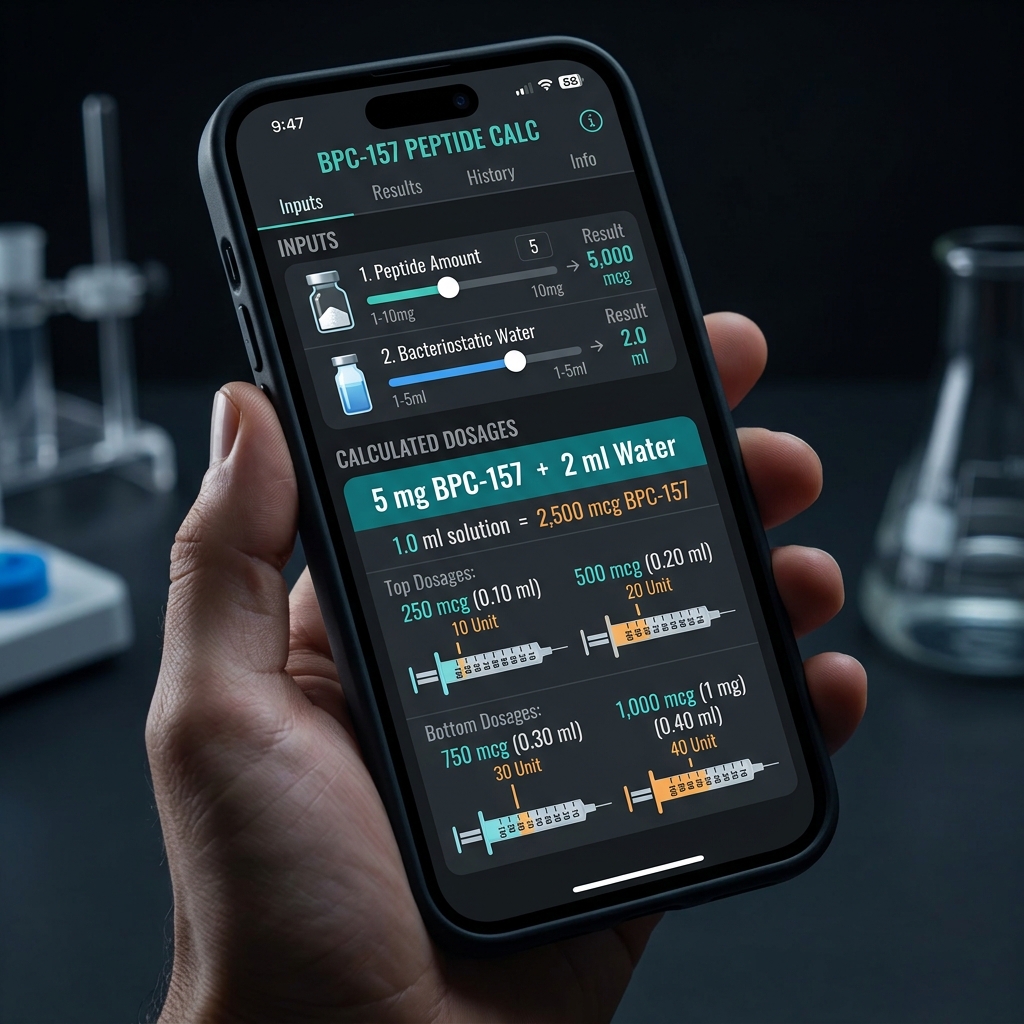
A peptide calculator is a digital utility designed to automatically determine the exact microgram (mcg) concentration per tick mark on a standard syringe, based on the total mass of the lyophilized powder and the volume of solvent added.
Manual mathematics in the laboratory introduces the risk of human error. While the baseline formulas are straightforward, adjusting for different vial sizes (e.g., 5mg vs. 10mg) and varying syringe volumes (U-100 vs. U-50) complicates mental math. A momentary lapse in decimal placement can turn a 250mcg dose into a 2,500mcg error.
According to the research standards set by 99 Purity Peptides, automating this process is the most effective way to ensure protocol consistency. Elite researchers rely on the interactive peptide calculator to verify their manual math instantly. Utilizing a validated digital tool guarantees that concentration variables are strictly controlled before any research begins.
Understanding the Math: Milligrams vs. Micrograms
The fundamental rule of peptide mathematics is understanding unit conversion: Milligrams (mg) measure the total dry mass in the vial, while micrograms (mcg) measure the specific liquid dose drawn for research.
Before utilizing any formula or tool, researchers must be completely fluent in this conversion:
1 mg = 1000 mcg
When you receive a vial labeled "5mg," you possess 5,000mcg of raw compound. If your research protocol dictates a 250mcg application, you cannot simply measure the dry powder. The powder must be suspended in a solvent—most commonly bacteriostatic water—so that the researcher can draw out a specific fraction of that 5,000mcg total.
Understanding how much water to add is where the concentration formula becomes essential.
The Reconstitution Formula (C1V1 = C2V2)
Concentration is defined as the mass of the solute divided by the volume of the solvent. By controlling the volume of bacteriostatic water added, researchers dictate how concentrated or diluted the resulting liquid will be.
The universal formula applied in this laboratory setting is:
Concentration = Mass (mg) / Volume (ml)
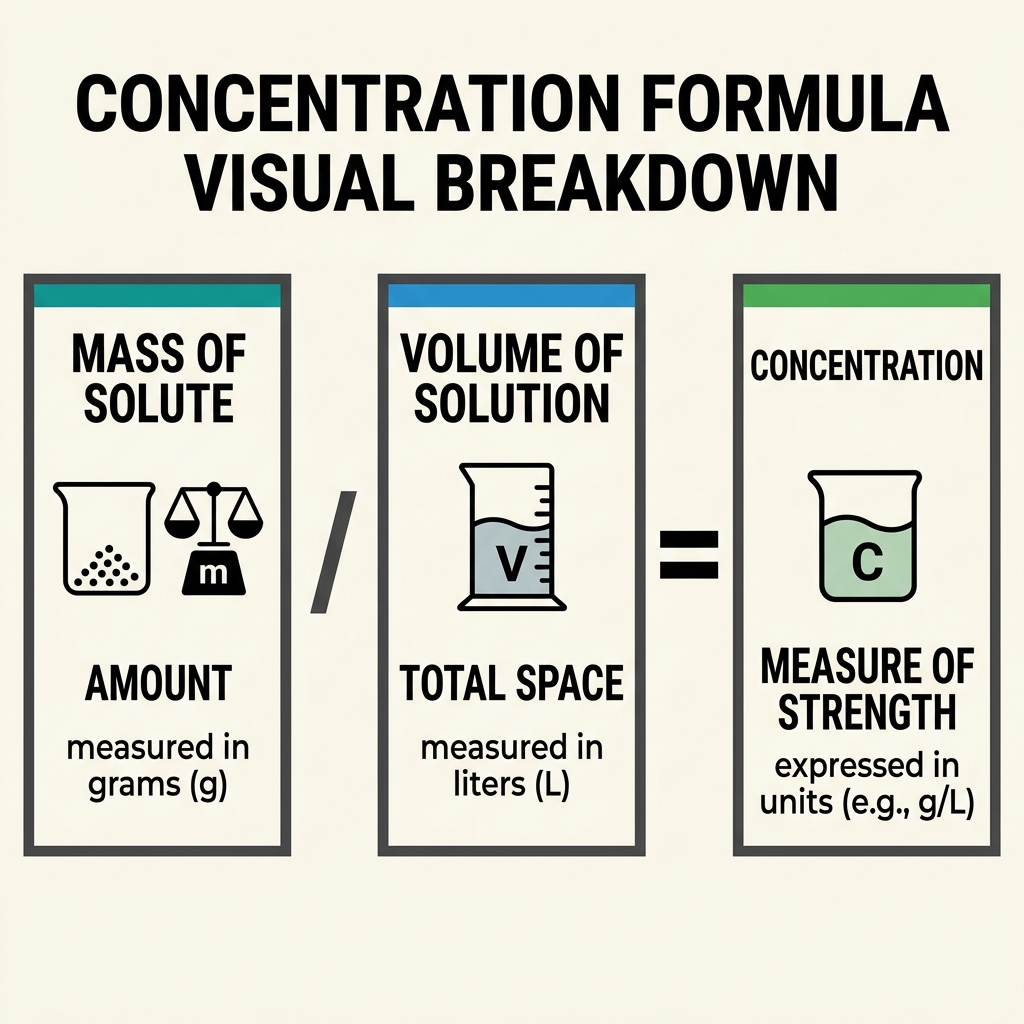
If you add 2ml of bacteriostatic water to a 5mg vial, your resulting concentration is 2.5mg per 1ml. Because 2.5mg equals 2,500mcg, a standard U-100 syringe (which holds exactly 1ml partitioned into 100 "ticks" or units) will contain 25mcg per tick.
Standard Water Volume to Concentration Reference Table
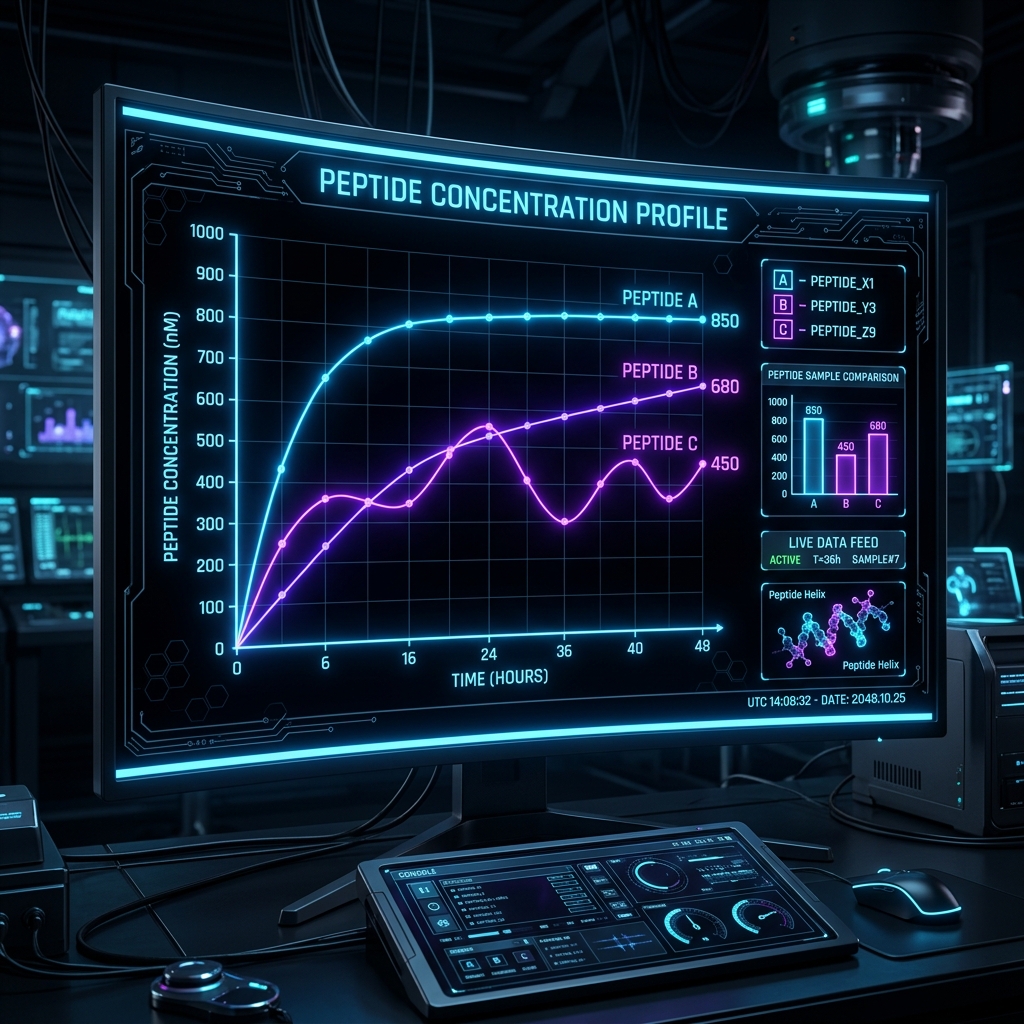
The following chart outlines the concentration yields when mixing a standard 5mg and 10mg vial with varying volumes of bacteriostatic water.
| Vial Size (Mass) | Bac Water (Volume) | Total mcg in Vial | Yield per 1ml | Yield per U-100 Tick (1/100th ml) |
|---|---|---|---|---|
| 5mg | 1ml | 5,000 mcg | 5,000 mcg | 50 mcg |
| 5mg | 2ml | 5,000 mcg | 2,500 mcg | 25 mcg |
| 5mg | 3ml | 5,000 mcg | 1,666 mcg | ~16.6 mcg |
| 10mg | 1ml | 10,000 mcg | 10,000 mcg | 100 mcg |
| 10mg | 2ml | 10,000 mcg | 5,000 mcg | 50 mcg |
| 10mg | 3ml | 10,000 mcg | 3,333 mcg | ~33.3 mcg |
Research Note: Standardizing your protocols by always using 2ml of bacteriostatic water for 5mg vials greatly reduces calculation friction across multiple experiments.
The Belk Body Lab 4-Step Reconstitution Protocol
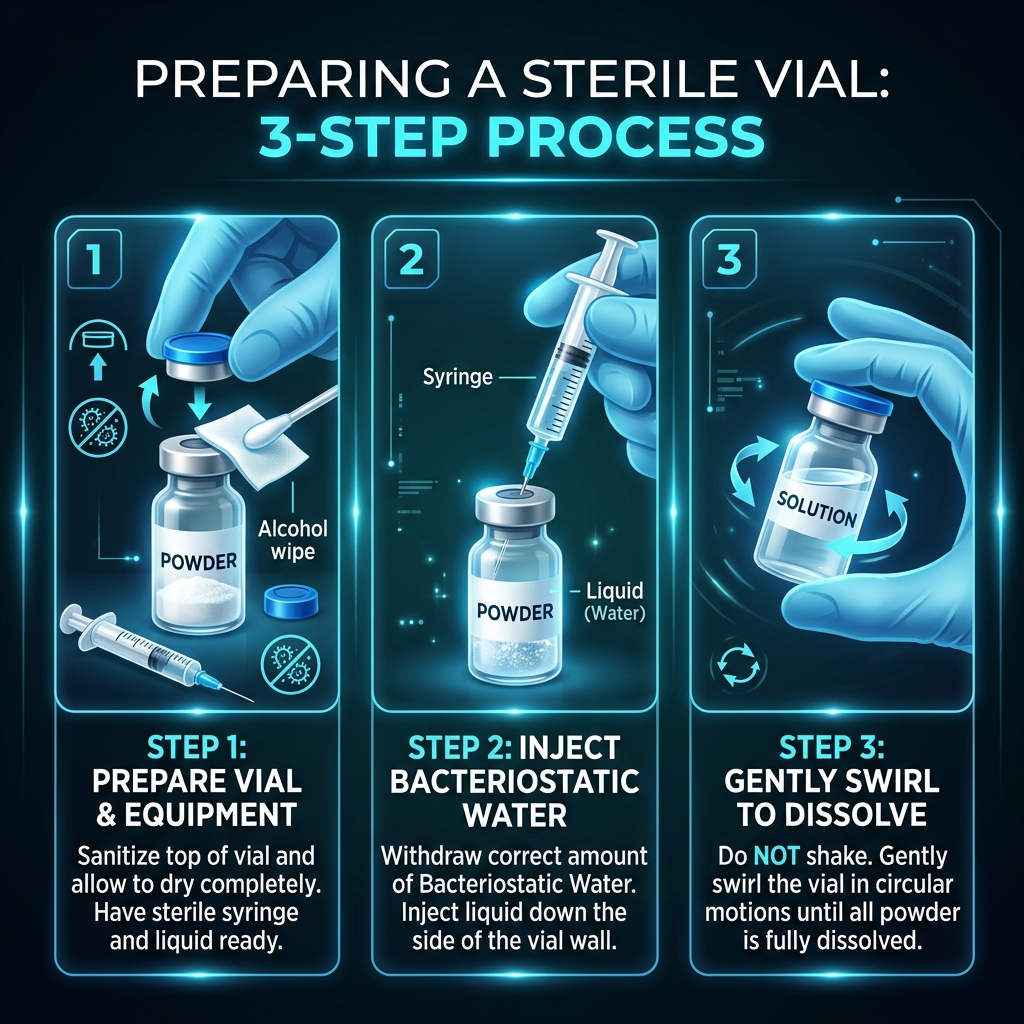
To maintain maximum compound stability and prevent degradation, physical handling must be executed with precision. Improper mixing can destroy fragile peptide bonds. Whether studying the regenerative properties of BPC-157 or mapping the preclinical data of Retatrutide, researchers should follow this standardized framework.
Step 1: Preparation & Sterilization
Begin by establishing a clean environment. Swab the rubber stoppers of both the bacteriostatic water and the lyophilized peptide vial with a 70% isopropyl alcohol wipe. Allow the alcohol to evaporate completely. Ensure both vials have reached room temperature to prevent condensation from affecting the solvent.
Step 2: Equalizing Pressure (The Vacuum Effect)
Peptide vials are sealed under negative pressure (a vacuum) to preserve the structural integrity of the lyophilized powder during transport. Before drawing bacteriostatic water, pull air into your syringe equal to the volume of water you intend to extract. Inject this air into the bacteriostatic water vial to equalize pressure, making it vastly easier to draw the fluid smoothly and without air bubbles.
Step 3: Adding Bacteriostatic Water
Draw the required volume of bacteriostatic water. Pierce the rubber stopper of the peptide vial at an angle. Do not shoot the water directly onto the powder puck. The vacuum inside the vial will naturally pull the water from the syringe. Guide the stream down the inside glass wall of the vial. Direct impact can sheer the peptide bonds and cause rapid degradation.
Step 4: Swirling and Storage
Once the solvent is added, remove the syringe. Never shake the vial. Shaking creates mechanical stress and aeration, which ruins the compound. Instead, gently roll or swirl the vial between your fingers until the powder is fully dissolved and the liquid is perfectly clear. Once mixed, the compound must be immediately transferred to a refrigerator (between 2°C and 8°C) to maintain stability.
Top 5 Mistakes in Peptide Reconstitution
Even experienced researchers can compromise their studies by neglecting basic chemistry principles. Avoid these common laboratory errors:
- Shaking Instead of Swirling: Mechanical sheering from vigorous shaking breaks down the amino acid chains, rendering the solution inert.
- Using the Wrong Water: Relying on basic sterile water rather than bacteriostatic water. Bacteriostatic water contains 0.9% benzyl alcohol, which acts as a preservative to prevent bacterial growth for up to 28 days.
- Ignoring Displacement: Failing to account for the slight volume the powder itself adds to the liquid. While minor in 5mg vials, displacement matters in high-mass compounds.
- Forcing the Plunger: Injecting water too forcefully into the vial rather than letting the vacuum gently pull the solvent down the glass wall.
- Re-freezing Reconstituted Peptides: Lyophilized powder should be stored in the freezer, but once reconstituted with liquid, freezing will destroy the peptide structure. Mixed vials belong in the refrigerator.
Conclusion & Next Steps
Key Takeaways
- 1mg of lyophilized powder is always equal to 1,000mcg.
- Concentration is determined entirely by how much bacteriostatic water is added to the vial.
- Never shake a vial; let the vacuum pull the water down the glass wall, and gently swirl to mix.
- Always use a digital calculator to verify manual mathematics before beginning physical research.
Mastering peptide reconstitution requires strict adherence to mathematical principles and physical laboratory protocols. By understanding how to manipulate solvent volumes to achieve precise microgram concentrations, researchers eliminate variables and ensure the integrity of their data.
Do not leave your study parameters to chance or mental math. Verify your reconstitution ratios instantly using the interactive peptide calculator.
For laboratories looking to source strictly tested, third-party verified materials, explore the full catalog of high-purity research compounds available at 99 Purity Peptides, or continue your education by reviewing our advanced laboratory protocols.
Questions &
Answers
If your question isn't answered here, reach out directly — Kyle responds personally.
A peptide calculator is a digital laboratory tool used to accurately convert milligrams to micrograms and determine exact syringe dosages based on the total mass of lyophilized powder and the volume of bacteriostatic water added.
The standard laboratory protocol for a 5mg vial is to add 2ml of bacteriostatic water. This yields a concentration of 2.5mg per 1ml, making calculations on standard syringes straightforward (25mcg per tick).
